
Cargo Van vs. Utility Trailer for Small Moves

Table of Contents
Cargo Van Rental for Moving: Capacity and Features
Utility Trailer Rental for Moving: What You Get
How Much Fits in a Cargo Van for Your Move
Real-World Inventory Examples
Packing Efficiency and Vertical Space
Weight Capacity vs. Volume Constraint
Quick Inventory Checklist
Electronics and Fragile Items
Moving Furniture in a Utility Trailer Safely
Cargo Van vs. Utility Trailer: Cost, Towing, and Protection
Total Cost Breakdown with Real Examples
Towing Requirements and Safety: Load Distribution and Brake Mechanics
Weather and Item Protection
Choosing the Right Option for Your Small Move
Frequently Asked Questions
Last Updated: October 11, 2026
Cargo Van Rental for Moving: Capacity and Features
A cargo van is an enclosed, self-propelled vehicle you drive yourself for a cargo van utility trailer small move, no towing experience needed. It offers weather protection and easy maneuverability for household items, furniture, and boxes in a single trip.
Cargo vans come in two sizes: standard (10 feet) and extended (13-15 feet). Standard vans fit residential parking spaces and tight corners; extended vans carry more volume but require careful navigation in congested areas.
Most cargo vans offer 200-300 cubic feet of usable space, roughly 8-12 rooms' worth of boxes, a bedroom set, or mixed furniture. Interior height (5-6 feet) accommodates mattresses standing upright and standard bookcases.
You control the loading and unloading pace, which matters during downsizing or estate cleanouts. The trade-off: you handle the physical labor yourself unless you arrange separate help, a significant consideration for seniors or anyone with mobility concerns.
Utility Trailer Rental for Moving: What You Get
A utility trailer is a non-motorized, towed vehicle ranging from small 4x8 open designs to larger 6x12 enclosed models. Open designs expose cargo to weather; enclosed versions protect furniture and electronics.
A small open utility trailer holds 800-1,200 pounds (light loads); a larger enclosed trailer handles 2,000-3,500 pounds (substantial furniture and mixed household loads).
Your personal vehicle remains unloaded for passengers and other tasks during the move. Open trailers suit dry-weather moves; enclosed trailers protect against rain, dust, and UV damage, essential for furniture finishes, electronics, and upholstered pieces.
The challenge: you need a vehicle with adequate towing capacity (usually 1,500-3,500 pounds) and must manage weight distribution, hitching technique, and brake coordination.
How Much Fits in a Cargo Van for Your Move
Capacity depends on interior volume and packing efficiency. Standard cargo vans offer 200-250 cubic feet; extended vans offer 300-350 cubic feet. But cubic feet alone don't tell you what actually fits.
Real-World Inventory Examples
One-bedroom apartment (standard cargo van, 200-250 cubic feet):
Bedroom: Queen bed frame and mattress, dresser, nightstand, desk, office chair
Living room: Sofa, coffee table, TV stand, bookshelf
Kitchen: Microwave, toaster, small appliances, dishes and cookware (packed in boxes)
Bathroom: Toiletries, towels, cleaning supplies
Miscellaneous: 150-200 boxes of clothing, books, and personal items
Typical fit: Yes, in one trip
Studio apartment or dorm room (standard cargo van):
Bed frame and mattress, dresser, desk, chair, small bookshelf
80-120 boxes of clothing and personal items
Small appliances and kitchenware
Typical fit: Yes, with room to spare
Two-bedroom home (extended cargo van, 300-350 cubic feet):
Two bed frames and mattresses, two dressers, two nightstands
Living room: Sofa, loveseat or second seating, coffee table, TV stand, bookshelf
Dining room: Table and 4-6 chairs
Kitchen appliances and cookware
250-350 boxes
Typical fit: Tight; may require a second trip or extended van
Estate cleanout or downsizing (extended cargo van):
Multiple bedroom sets, dining furniture, living room pieces, kitchen items
300+ boxes of accumulated household goods
Typical fit: Depends on quantity; often requires two trips
Packing Efficiency and Vertical Space
Packing efficiency depends on item shapes and arrangement. Uniform boxes use space efficiently; irregular furniture and bulky items consume proportionally more space.
Maximize vertical space: Queen mattresses stand upright (5 feet) with room for boxes above. Remove dresser drawers and bookcase shelves to reduce height 30-40%. Nest dining chairs to save 50-60% of space.
Protect items: Wrap furniture legs and glass surfaces in moving blankets. Place heavier boxes on the bottom. Secure tall items to van walls with rope or straps. Keep fragile items in the middle of the load, surrounded by boxes for cushioning.
Weight Capacity vs. Volume Constraint
Most household goods don't approach a cargo van's weight capacity (3,000-4,000 lbs). The constraint is volume. However, weight matters if you're moving books, tools, or heavy appliances. Distribute heavy boxes throughout the van rather than stacking them in one corner, which can overload the suspension.
Quick Inventory Checklist
Use this checklist to estimate whether a standard or extended cargo van suits your move:
Count your items:
Bed frames: ___
Mattresses: ___
Dressers/nightstands: ___
Sofas/chairs: ___
Dining table and chairs: ___
Bookcases/shelving: ___
Estimated boxes (count closets, cabinets, and shelves): ___
If your total is:
1 bed, 1 dresser, 1 sofa, 1 table, 100-150 boxes → Standard cargo van
2 beds, 2 dressers, 2 sofas, 1 table, 200-250 boxes → Extended cargo van or two standard vans
3+ beds, multiple furniture sets, 300+ boxes → Extended cargo van (may require two trips) or utility trailer
Electronics and Fragile Items
Electronics and fragile items benefit from the enclosed environment of a cargo van, no exposure to rain, dust, or road debris. Pack electronics in their original boxes if available; otherwise, wrap them in blankets and place them in sturdy boxes labeled "FRAGILE." Keep them in the middle of the load, surrounded by softer items for cushioning.
If your inventory doesn't fit in a standard van, an extended van usually solves the problem. If an extended van is still tight, a utility trailer or second trip becomes necessary.
Moving Furniture in a Utility Trailer Safely
Furniture transport in a utility trailer requires deliberate planning. Unlike a cargo van, a trailer offers only a flat bed.
Place heaviest items first, dressers, bed frames, tables, toward the front of the trailer for towing stability. Lighter items, boxes, and chairs go on top or toward the back.
For enclosed trailers, use rope, straps, or tie-downs to anchor furniture to the trailer's D-rings or frame. Cross-bracing prevents sliding.
Open trailers demand additional care. A tarp or moving blankets protect furniture from rain and road debris. Secure the covering tightly so it doesn't flap or come loose during transit.
Disassemble furniture when possible, remove table legs, bed frame rails, and sofa feet to reduce height and improve stability. Keep hardware in labeled bags and photograph assembly configuration before disassembly.
For items like china cabinets, dressers with mirrors, or glass-topped tables, transport them inside an enclosed trailer whenever possible. The protection is worth the rental upgrade.
Cargo Van vs. Utility Trailer: Cost, Towing, and Protection
Total Cost Breakdown with Real Examples
Cost comparison requires itemizing rental fees, fuel, insurance, and potential extra trips:
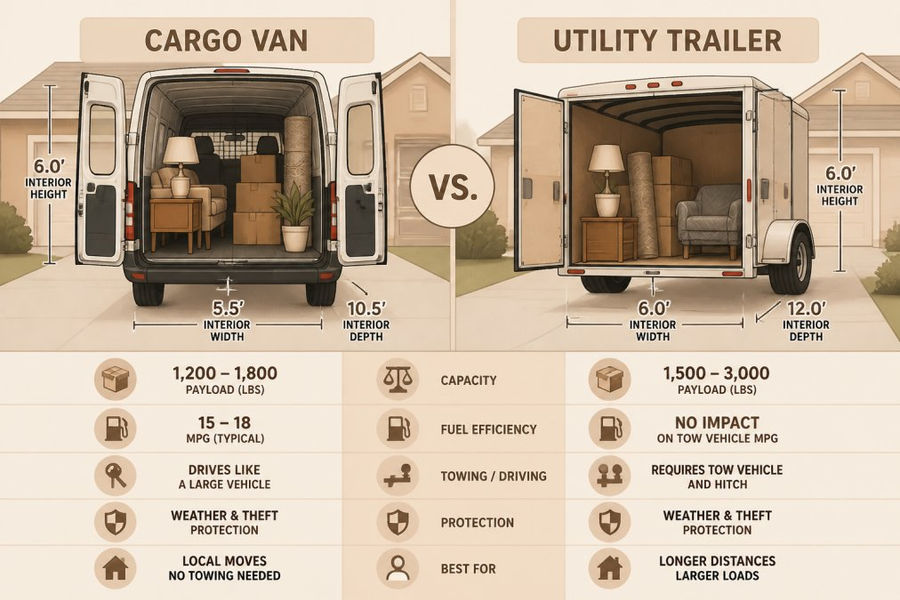
Cargo Van (Standard, 10-foot) for a 30-mile local move:
Rental (one day): $50-$80
Fuel (estimated 4-5 gallons at 10 mpg): $16-$20
Damage waiver/insurance: $15-$25
Total: $81-$125 for one trip
Utility Trailer (6x12 enclosed) for the same move:
Trailer rental (one day): $40-$60
Fuel for towing vehicle (estimated 6-8 gallons at 12 mpg): $24-$32
Damage waiver: $10-$15
Total: $74-$107 for one trip
For moves under 50 miles, costs are comparable. For longer distances (100+ miles), the cargo van's higher fuel consumption ($40-$60 in fuel alone) can exceed the trailer option by $30-$50, even accounting for the trailer's rental fee.
Hidden costs include mileage overages ($0.25-$0.50 per mile), late fees ($25-$50), and extra trips. For a one-bedroom apartment move, a cargo van trip typically costs $100-$150 total.
Towing Requirements and Safety: Load Distribution and Brake Mechanics
Not every vehicle can tow a utility trailer safely. Your vehicle's owner manual specifies its maximum towing capacity, the total weight the vehicle can pull.
Common towing capacities:
Compact cars (Honda Civic, Toyota Corolla): 1,000-1,500 lbs
Mid-size sedans (Honda Accord, Toyota Camry): 1,500-2,000 lbs
Small SUVs (Honda CR-V, Toyota RAV4): 1,500-2,500 lbs
Full-size trucks (Ford F-150, Chevy Silverado): 5,000-14,000 lbs
A 6x12 enclosed utility trailer loaded with furniture typically weighs 2,500-3,500 lbs. Most sedans and compact SUVs cannot safely tow this weight. A small open trailer (4x8) weighs 800-1,200 lbs but offers no weather protection.
Weight distribution: 60% of trailer weight should sit forward of the axle, 40% behind. Place heavy furniture near the front to prevent swaying.
Brake coordination: Trailers with electric brakes require a brake controller. Without it, stopping distances increase and jackknifing becomes likely. Installation costs $300-$500.
Avoid towing if: your vehicle's towing capacity is insufficient, you've never towed before, weather is poor, or your vehicle lacks a brake controller.
Hitching mechanics: Verify the coupler is fully seated on the ball, safety chains are crossed and tight, and the electrical connector is secure before leaving.
Weather and Item Protection
Enclosed cargo vans and enclosed utility trailers both shield items from rain, sun, and dust. Open utility trailers leave cargo exposed to all weather elements.
During humid or rainy weather, open trailers allow moisture to accumulate, risking mold, mildew, and rust. Upholstered pieces absorb moisture and can develop odors or structural damage. Electronics may malfunction immediately or fail weeks later.
Enclosed options cost $10-$20 more per day than open trailers but justify the expense for:
Upholstered furniture (sofas, chairs, ottomans)
Electronics (TVs, computers, stereo equipment)
Wooden furniture with finishes (dressers, tables, bookcases)
Mattresses and bedding
Items sensitive to temperature swings (some antiques, musical instruments)
For short moves on clear-weather days, an open trailer works for hardy items. For anything fragile, upholstered, or moisture-sensitive, enclosed transport is safer.
If you must use an open trailer, protect cargo with a heavy-duty tarp secured tightly. Wrap furniture legs and corners in moving blankets. Road debris can still damage finishes and upholstery.
A cargo van eliminates this concern entirely. Everything stays dry and protected, regardless of weather.
Choosing the Right Option for Your Small Move
The decision depends on three factors: inventory size, towing comfort, and protection needs.
Choose a cargo van if:
You need to move a one-bedroom apartment or smaller household
You're uncomfortable with towing or your vehicle lacks towing capacity
You want weather protection without negotiating a second vehicle
You prefer simplicity: rent one vehicle, load it, drive it, unload it
You're managing a senior's downsizing and need straightforward logistics
Choose a utility trailer if:
Your vehicle has adequate towing capacity and you're comfortable towing
You need to make multiple trips (the trailer stays, your vehicle remains available)
Your budget is tight and you're moving lightweight items in dry weather
You're combining the move with other hauling tasks where a trailer's flexibility helps
For most small moves, especially downsizing, apartment relocations, and estate cleanouts, a cargo van utility trailer small move option offers simplicity and reliability.
Our people-first approach means we listen to your situation and recommend what actually works for your move, not what generates the highest rental fee.
Option | Best For | Capacity | Towing Required | Weather Protection |
Standard Cargo Van | One-bedroom apartments, single rooms | 200-250 boxes + furniture | No | Full |
Extended Cargo Van | Two-bedroom homes, larger estates | 300+ boxes + multiple rooms | No | Full |
Small Open Trailer | Light loads, dry weather | 800-1,200 lbs | Yes | None |
Large Enclosed Trailer | Furniture, multi-room moves | 2,000-3,500 lbs | Yes | Full |
[IMAGE: Side-by-side view of a loaded cargo van and enclosed utility trailer parked in a residential driveway, showing open cargo doors and interior space arrangement with boxes and furniture visible | section:Cargo Van vs.
Choosing between a cargo van and utility trailer comes down to your specific move.
At Legacy Lift, we specialize in making small moves stress-free. Our fleet includes both open and covered utility trailers plus cargo van options, and we offer delivery and setup assistance to handle the heavy lifting.
Frequently Asked Questions
Is a cargo van or utility trailer cheaper for a small move?
Cost depends on rental duration, distance, and your vehicle's towing capacity. Cargo vans typically have lower daily rental rates but higher fuel costs per mile. Utility trailers cost less to fuel but require a compatible towing vehicle. Get a quote from Legacy Lift to compare total expenses for your specific move, pricing varies by dates, distance, and trailer size.
How much can a cargo van hold for moving?
A standard cargo van holds 200-300 cubic feet of cargo, fitting roughly 1-2 rooms of household belongings. Interior dimensions vary, but most accommodate a queen mattress, several dressers, and multiple boxes. Payload capacity (typically 1,500-2,500 pounds) limits weight, not just volume. For mixed loads like furniture and boxes, you may need multiple trips or a utility trailer depending on item size and weight.
Do you need a special license to tow a utility trailer?
Most utility trailers under 10,000 pounds gross vehicle weight rating (GVWR) do not require a special license in most states. However, your vehicle must have adequate towing capacity (check your owner's manual), and you must follow state-specific braking and lighting requirements. Larger trailers may require endorsements. Verify your state's rules and your vehicle's limits before renting. Legacy Lift can advise on compatibility.
Can you protect belongings in an open utility trailer during a small move?
Open trailers expose items to weather, dust, and theft. Use tarps, weatherproof covers, and secure straps to protect furniture and boxes. For high-value or sensitive items (mattresses, electronics, antiques), an enclosed cargo van or covered trailer offers better protection. Legacy Lift offers both open and covered trailer options, choose based on weather conditions, item type, and your move distance.
BOOK NOW


Comments