
Best Trailer Rental for Moving Furniture: 2026 Guide

Table of Contents
How to Choose the Best Trailer Rental for Moving Furniture
Top Trailer Rental Options for Moving Furniture
Legacy Lift: Concierge Trailer Rental with Delivery and Setup
The Home Depot: Utility and Flatbed Trailers for Mixed Loads
U-Pack: One-Way Moving Trailers Without the Towing
Penske: Car Towing and Moving Options for Long-Distance Moves
Budget: A Familiar Name in Moving Truck and Trailer Rentals
Furniture Moving Trailer Size: What Fits and What Doesn't
Trailer Rental Cost: What Affects Your Total
One-Way Trailer Rental vs. Local Round-Trip
How to Secure Furniture in a Trailer
What to Check Before You Tow: Vehicle Compatibility and Safety
Which Trailer Rental Is Right for Your Move?
Frequently Asked Questions
Last Updated: October 16, 2026
How to Choose the Best Trailer Rental for Moving Furniture
Finding the best trailer rental for moving furniture comes down to three things: what you're hauling, how far it's going, and whether you want to tow it yourself. At Legacy Lift, we've helped families work through that exact decision during downsizing moves, estate cleanouts, and everything in between.
The stakes are higher than a typical rental. A sofa, a china cabinet, and a mattress don't forgive a bad call on trailer size or tie-downs. Choose wrong and you're making two trips, or worse, watching a dresser slide on the highway.
Here's the good news: the options are narrower than they look. Most furniture moves fit into one of five rental paths, and once you know your load weight and your tow vehicle's rating, the choice usually makes itself.
Key Takeaway Match the trailer to the load, not the other way around. Weigh your heaviest furniture first, then check your vehicle's towing capacity. Everything else follows from those two numbers.
Top Trailer Rental Options for Moving Furniture
Five rental paths cover nearly every furniture move. We rank them by how well each handles the specific demands of household goods: padding, securing, and protecting finished surfaces.
Option | Best For | Towing Required | Furniture Protection |
Legacy Lift | Senior downsizing, estate moves, full-service moves | Optional | Enclosed and covered trailers |
The Home Depot | Mixed loads with debris or equipment | Yes | Open utility and flatbed |
U-Pack | Long-distance moves without towing | No | Enclosed moving trailer |
Penske | Moves that include a car | Yes | Varies by unit |
Budget | Comparison shopping before booking | Yes | Varies by unit |
Legacy Lift: Concierge Trailer Rental with Delivery and Setup
Furniture is the hardest thing to move well. It's heavy, it scratches, and it doesn't stack. The right trailer solves most of that, and the right help solves the rest.
Legacy Lift is a locally owned trailer concierge and rental company built around life transitions: senior downsizing, retirement moves, estate cleanouts, and the moves that follow a death or divorce.

What works: For families handling a parent's move from out of state, delivery and setup removes the hardest logistics problem.
What doesn't: We're a local operation, not a national network.
The Home Depot: Utility and Flatbed Trailers for Mixed Loads
The Home Depot rents utility, dump, and flatbed trailers, which makes it a reasonable fit when your move includes more than furniture.
The catch for furniture specifically: an open utility trailer leaves your sofa exposed to rain and road spray, and finished wood doesn't recover from a wet drive.
Best for: Renters whose furniture move also requires hauling equipment or bulky debris. Watch for: No furniture-specific guidance and no published pricing in the material available to us. Call the location before you count on it.
U-Pack: One-Way Moving Trailers Without the Towing
U-Pack appears in moving-trailer comparisons as the option for people who don't want to tow. That's the whole appeal. You load a trailer that's dropped at your home, and the company moves it.
For anyone who has never pulled a trailer, this removes the riskiest part of the job. It also removes the cost of a tow vehicle you may not own.
Best for: Long-distance furniture moves where towing isn't realistic. Watch for: You're paying for a moving service, not a rental, and the supplied information doesn't detail trailer specifications or pricing. Get a written quote before committing.
Penske: Car Towing and Moving Options for Long-Distance Moves
Penske shows up in moving-trailer comparisons as a choice for towing a car. That matters if your move involves both household furniture and a second vehicle.
Best for: Movers who need a car-towing option alongside the furniture load. Watch for: The supplied information doesn't verify furniture trailer types or specifications, and it doesn't include pricing. Confirm what's actually available at your pickup location.
Budget: A Familiar Name in Moving Truck and Trailer Rentals
Budget appears in comparisons of moving trailer rental companies.
Best for: Movers comparing providers before booking. Watch for: The supplied information doesn't specify trailer types or furniture-moving features, and it doesn't include pricing. Treat it as one quote among several, not a default.
Furniture Moving Trailer Size: What Fits and What Doesn't
Furniture moving trailer size is the single decision that causes the most second trips. Rent too small and you're paying for the trailer twice. Rent too large and you're hauling empty air.
Most household furniture moves fit into one of three bands:
5x8 to 6x12 feet: A studio or one-bedroom's worth of furniture. A sofa, a bed frame, a dresser, and a dozen boxes.
6x12 to 7x14 feet: Two to three bedrooms. Sectional, dining table and chairs, multiple dressers, mattresses, and boxed goods.
7x16 feet and up: Full household moves, estate cleanouts, or anything with large appliances included.
The number that actually decides it isn't floor space. It's payload capacity, the weight a trailer can carry on top of its own weight.
Measure the tallest and longest single item before you book. A couch that won't fit through the door of an enclosed trailer is a problem no amount of strapping fixes.
Pro Tip Photograph your three bulkiest items with a tape measure in frame before you call to book. A rental provider can size your trailer accurately from those photos in one conversation instead of three.
Trailer Rental Cost: What Affects Your Total
Trailer rental cost is rarely a single number. The advertised rate is one line on the final bill, and the rest depends on how you use the trailer.
What moves the total:
Rental duration. Daily rates compound fast. A move that slips two days can cost more than the trailer itself.
One-way versus round-trip. One-way rentals price in the repositioning, so they cost more than a local round-trip of the same length.
Mileage fees. Many rentals include a mileage allowance and charge per mile beyond it. Long moves can push this line item past the base rate.
Insurance and damage protection. Optional coverage adds to the total, and it's worth reading what it actually covers before you decline it.
Delivery and setup. If you'd rather not tow, delivery adds a service fee but can remove the cost of renting a capable tow vehicle.
Fuel. Towing cuts fuel economy noticeably. Budget for it on any move over an hour of driving.
We don't publish flat rates because the honest answer is that pricing depends on trailer size, rental length, and whether you want delivery. Ask for a written quote that itemizes base rate, mileage, and coverage.
Watch Out The most common cost surprise is the mileage fee. Ask for the per-mile rate in writing before you sign.
One-Way Trailer Rental vs. Local Round-Trip
One-way trailer rental makes sense when your move ends somewhere you don't plan to return from.
Round-trip rental wins on price for local moves. If your new home is 20 minutes away, towing the trailer back costs you one extra trip and saves the one-way premium.
The decision framework is simple:
Moving within the same area, same day: Round-trip. Always.
Moving to another city and staying: One-way, if the provider offers a drop-off location near your destination.
Moving to another city and coming back: Round-trip, unless the return drive is impractical.
Availability is the hidden constraint. One-way drop-off locations aren't unlimited, and a destination without a participating location turns a one-way move back into a round-trip. Confirm the drop-off location exists before you book, not after you've loaded.
How to Secure Furniture in a Trailer
Securing furniture in a trailer comes down to four things: wrap it, pad the contact points, strap it to the structure, and fill the gaps so nothing shifts. Loaded correctly, furniture rides a trailer as safely as it rides a moving truck.
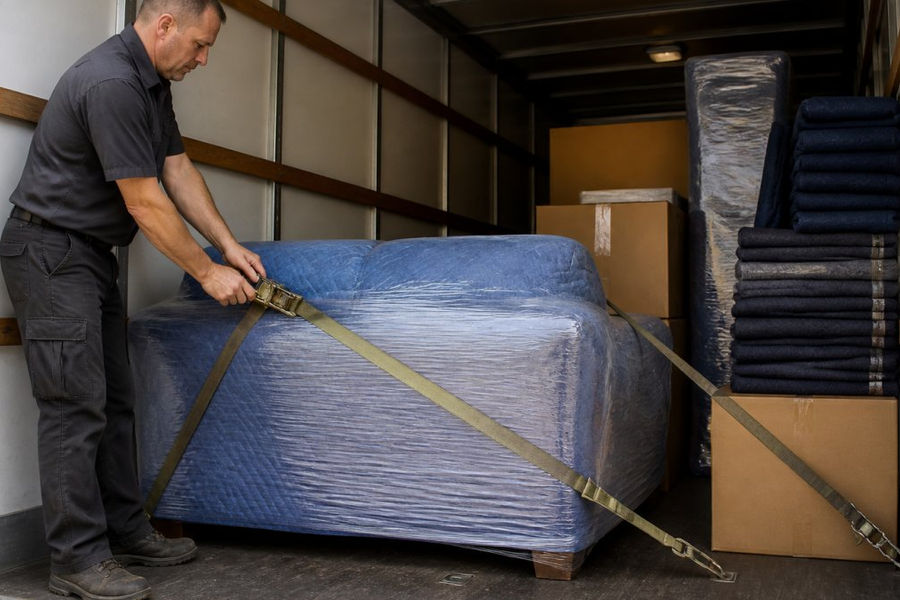
The loading sequence that works:
Wrap first. Moving blankets and stretch wrap on every finished surface. Corners take the worst damage and are the hardest to repair.
Load heavy items over the axles. Weight centered over the trailer's axles keeps tongue weight in range and prevents sway.
Strap to the trailer frame, not to other furniture. Tie-down points exist for this. Strapping a dresser to a sofa just means both move together.
Fill empty space. Boxes, bags of linens, and collapsed cardboard stop items from sliding. An empty trailer is a shifting trailer.
Check the load after 10 minutes of driving. Straps settle. Pull over, re-tighten, and then drive with confidence.
Pro Tip Put the mattress last and flat against a wall, not on the floor of the trailer. It's the lightest large item you own, and it doubles as padding for whatever it's leaning against.
What to Check Before You Tow: Vehicle Compatibility and Safety
Vehicle compatibility is where furniture moves fail before they start. Your tow vehicle needs the right hitch, the right hitch ball size, a working wiring harness, and a towing capacity that exceeds the loaded trailer weight.
Run this checklist before you leave the driveway:
Confirm your vehicle's towing capacity in the owner's manual, not from memory
Match the hitch ball size to the trailer coupler
Test the wiring harness: brake lights, turn signals, running lights
Check trailer tire pressure and tread
Confirm trailer brakes work if the trailer is equipped with them
Verify the safety chains cross under the coupler
Set tongue weight so the trailer sits level, not nose-up
Adjust mirrors before you pull out
If you've never towed, the honest advice is not to learn on a loaded trailer full of your mother's furniture. Practice in an empty parking lot first, or choose a provider that handles delivery and setup so towing never enters the equation.
Which Trailer Rental Is Right for Your Move?
The right trailer rental depends on three answers: how much furniture you have, how far it's going, and whether you want to tow. Full-service moves with senior downsizing or estate cleanouts point toward a concierge option. Long-distance moves without a tow vehicle point toward a moving service. Local moves with a capable truck point toward a round-trip rental.
If your move involves a parent's home, a lifetime of belongings, and a deadline you didn't choose, the logistics matter less than the support around them.
Frequently Asked Questions
What size trailer do I need to move a couch?
A standard three-seat sofa typically needs a 6x12-foot trailer at minimum. Measure your couch first, then compare against the trailer's interior dimensions. Add extra space for padding and straps. If you are moving a couch plus other furniture, a 7x14 or larger enclosed trailer gives you room to load without cramming items against the walls.
How do I secure furniture in a rental trailer?
Wrap furniture in moving blankets, then use ratchet straps anchored to the trailer's tie-down points. Place heavier items on the floor toward the front, and stack lighter boxes on top. Push everything tight against the walls so nothing shifts during turns or braking. Check all straps after the first few miles of driving and tighten as needed.
Is an open or enclosed trailer better for moving furniture?
Enclosed trailers protect furniture from rain, road debris, and wind, making them the better choice for upholstered pieces, wood furniture, and electronics. Open utility trailers work for items that can handle weather exposure and are easier to load from the side. For most furniture moves, an enclosed trailer reduces the risk of damage during transit.
Can my vehicle tow a rental trailer?
Check your vehicle's towing capacity in the owner's manual before renting. You also need a properly rated hitch, a hitch ball that matches the coupler size, and a working wiring harness for lights. Trailers with brakes require a brake controller. If your vehicle is rated for the loaded trailer weight, you are ready to tow safely.
Moving furniture is stressful enough without adding trailer logistics to the list. Legacy Lift handles the parts most people dread: we deliver and set up your trailer, offer both open and covered options for whatever you're hauling, and provide professional assistance from pickup through drop-off. If you're managing a senior downsizing, an estate cleanout, or a family move and you'd rather not tow anything yourself, get started with Legacy Lift and let us take the trailer off your plate.
BOOK NOW
Comments